Solicitar precio
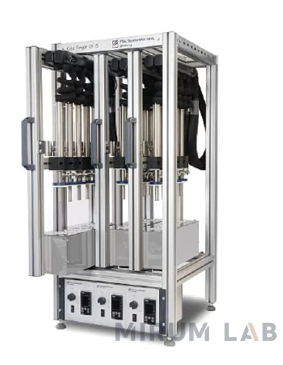
Cold Finger
Installation
Application:
- Determination of the degree of waxing and wax deposition
- Determination of the temperature at which paraffin deposition begins
- Wax Deposition Rate Study
- Development of paraffin deposit inhibitors
- Optimizing inhibitor concentration
- Sample quality control
- Number of test cells: 5 pcs. in each block, a maximum of 3 blocks (up to 15 cells).
- The cells are located in separate racks (blocks) with independent access, at least 5 cells and 5 rods in each rack (block).
- Possibility of access to each cooling rod without interrupting the experiment.
- Cell volume: 80-200 ml.
- Flow temperature in rods: - 10 to +60 °C (extended temperature range on request).
- Sample temperature: - 5 to + 80 °C (extended temperature range on request).
- Separate control of sample temperature and rod temperature.
- Accuracy of maintaining flow temperature (in air): no less than ± 0.5 °C.
- Independent temperature control for each cell block.
- Built-in magnetic stirrer for each cell.
- Mixing speed: from 0 to 2000 rpm.
- Possibility of independent access to each rack (block) with cells without interrupting the experiment.
- Individual control of mixing speed for each cell.
- Ability to control the experimental process using software.
- Possibility of separately setting and maintaining the temperature in each of the cells (in rods and samples) using software.
- Possibility of recording and storing data on the weight of rods in the software.
- Power supply:
Easy to use installation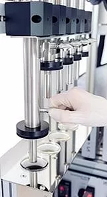
1) - Place the sample in a cold finger
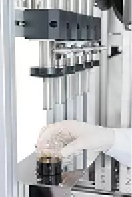
2) Lower your cold finger and measure
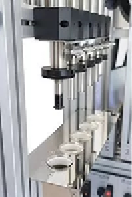
3) End of test: remove the cold pin bushing
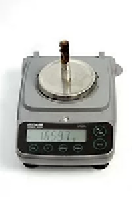
4) Weigh the cold sleeve and you're done!
Installation diagram
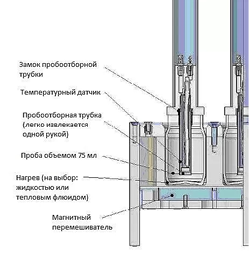 Operating principle of the device
The wax deposition process depends on many factors. Not only is the wax deposition temperature (WAT) important, but the total wax content of the oil and the shear effect of deposition are also important. The ColdFinger test bench is designed to investigate these factors.
The operating principle of the installation is based on creating a temperature difference between the cooling element (rod) and the container with mixed and heated oil. A temperature-controlled metal rod is immersed in the sample and cooled slowly. The paraffin components contained in the sample begin to precipitate on the surface of the rod. After a set period of time, the rod is removed. By weighing the rod and comparing the resulting weight with the original weight of the rod, you can determine the mass of the deposited paraffin. The final amount of precipitated paraffin indicates the degree of waxing of the sample. Depending on the degree of exposure to the sample, TNVP may be different. The rate of wax deposition depends not only on the temperature of the cooling rod, but also on the temperature of the sample and the speed of its mixing.
Standard delivery set:- ColdFinger main module – 1 pc.
- Rack (block) for 5 test cells – from 1 to 3 pcs.
- Test cells consisting of 80 ml sample containers and cooling rods with calibrated weights - 5 pcs. for each block of cells.
- Low Temperature Test Kit:
- Circulation thermostat-cryostat for controlling the flow temperature in rods with an operating temperature range from -10 to + 60 °C – 1 pc. for each block of cells.
- Circulation thermostat-cryostat for controlling the temperature of an oil sample with an operating temperature range from - 5 to + 80 °C – 1 pc. for each block of cells.
- Digital laboratory scales with external calibration. Weighing range 120 g, 1st accuracy class according to GOST R 53228-2008 – 1 pc.
- Built-in magnetic stirrer – 1 pc. for each block of cells.
- Set of control and measuring instruments – 1 set.
- Spare rods (stainless steel) with calibrated weight – 5 pcs.
- Sample containers with a volume of 80 ml – 5 pcs. for each block of cells.
- Workstation based on the latest generation PC – 1 set.
- Software for automated control of system operation – 1 copy.
- A set of accompanying documentation in Russian and English.
- Program for periodic metrological certification of the system.
Optional equipment:- Additional rack (block) for 5 test cells – expanding the maximum number of cells to 15 pcs.
- Extended delivery set for low temperature testing with rod temperatures down to -20 °C or -40 °C.
- Possibility of individual temperature control in each cell and each rod.
- High pressure test chambers (up to 172 bar).
- Circulation thermostats-cryostats of the Julabo and Huber brands.
Parameter Meaning Photosensitivity
O0.005 lux
Temperature Range
up to +200°С (+392°F)
Built-in temperature sensor
PT100
Branched light guide of optical sensor
Optical sensor for operation under ambient pressure conditions
stainless steel
Voltage
110/240 V, frequency 50/60 Hz