Solicitar precio
Analysis system for metalworking
Абразиметр
The DUCOM abrasion meter is a compact, benchtop, tribotechnical testing machine designed for testing materials for friction and wear in a controlled dry or liquid abrasive environment.
The system allows testing according to standard methods: ASTM G65, G105 and B611.
The device is designed to conduct research in conditions close to real ones.
The installation is fully automated and has a modern tabletop design.
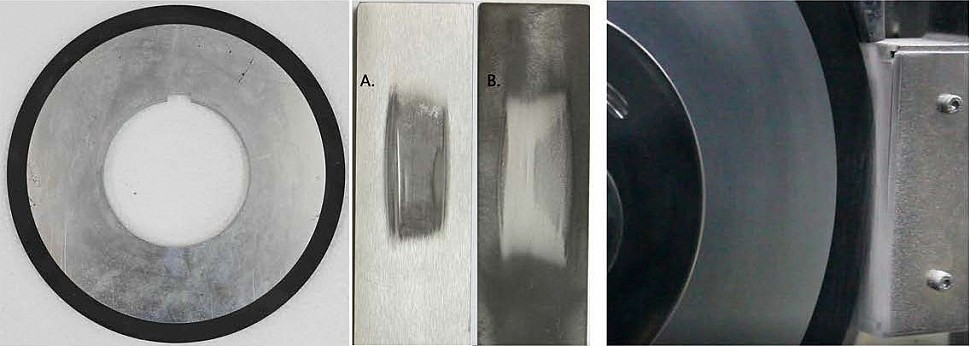
Rotating rubber disc
Samples studied
Test area in Ducom abrasion meter
APPLICATION AREA- Selection of materials based on their abrasive resistance (dry and liquid).
- Development and quality control of mold materials for the production of sand-lime bricks, in order to analyze and increase their resistance to erosive wear.
- Analysis in the field of refractory ceramics.
- Testing resistance to abrasive wear of hard coatings.
Key Features:- Simple tribometer design, compact and modern design;
- Short time to warm up the installation;
- Possibility of using various working fluids and sample materials (with and without coatings). The base material of the plate must be electrically conductive;
- Plate length can be measured by installing linear displacement transducers (LVDT);
- The presented tribometer layout allows for quick sample changes;
- The design of the tribometer is made of high-strength materials;
- The installation delivery set includes all necessary additional equipment and accessories for calibration and maintenance of the installation;
- Automatic generation of an experiment report.
ADVANTAGES OF THE DUCOM ABRAZIMETERVersatility:
The system allows you to simulate various abrasive wear conditions, such as dry abrasive wear, liquid abrasive wear, abrasive wear under elevated pressure and liquid heating. The device offers a full range of solutions to research problems associated with abrasive wear.
Automation:
A high degree of automation minimizes the influence of the human factor on the effectiveness of the experiment and guarantees the reliability and repeatability of experimental data.
Friction force measurement
The system allows you to measure the friction force during abrasion with a free abrasive in contact between two surfaces.
PRINCIPLE OF OPERATIONThe computer-controlled DUCOM Abrasive Meter is equipped with highly sensitive sensors to monitor load, abrasive flow, rotation speed and temperature. The test unit transfers the load to a rotating rubber/ceramic/metal disc using pneumatics. The rotation of the disk is controlled by a motor with a speed sensor. The suspension medium can be heated to 100°C. Abrasive particles from the hopper are fed into an electric motor, which controls the flow of particles until contact between the wheel and the block. During the test, the friction force sensor senses the friction between the disc, block and abrasive particles. All sensor data is displayed in the WinDucom program.
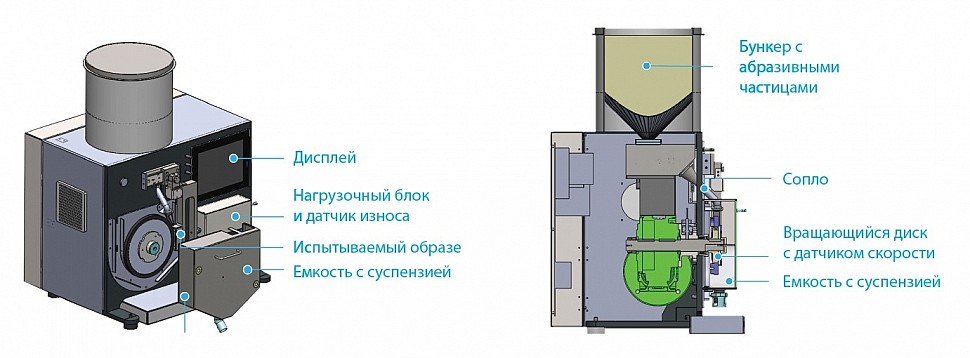
Schematic representation of the Ducom abrasimeter
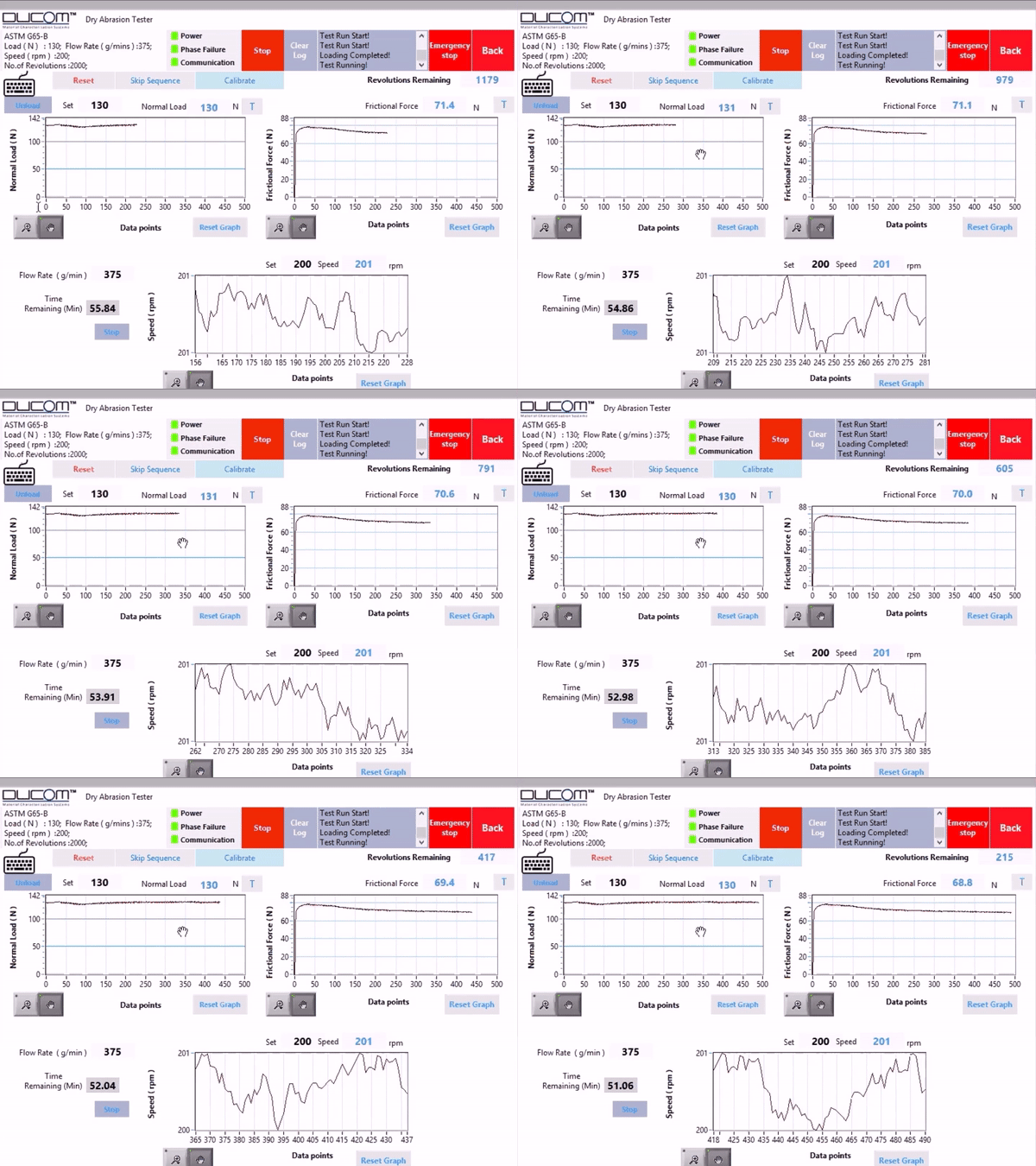
WinDucom program - displaying data in real time
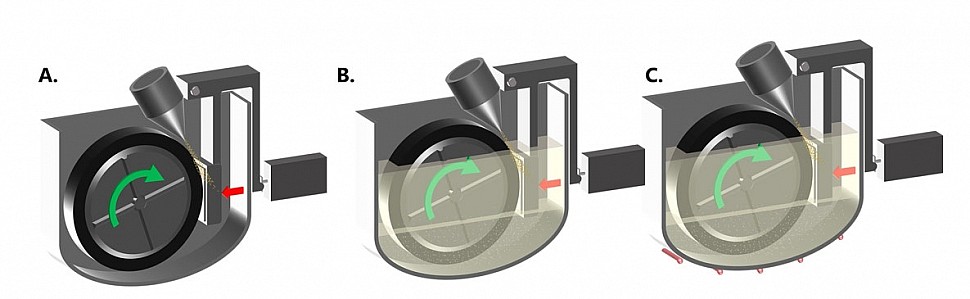
FUNCTIONAL FEATURES OF THE INSTALLATION- Dry Sanding Kit (A)
- Fluid Abrasive Kit (B)
- Fluid heating module (C)
- Wear indicator
 Specifications
Parameter Range Comments Overall dimensions, mm) 700x600x1000 - Weight (Kg) 80 - Load (N) 50-300 Accuracy ±1% Rotation speed (rpm) 50-250 - Abrasive feed (g/min) 300-400 - Friction force (N) 0-100 Accuracy ±1% Liquid heating (°C) 23-100 Optional CONTENTS OF DELIVERYAbrasimeter DUCOM - base unit
Load from 100 to 300N. Automated loading system.
Acceleration to 245 rpm
Rubber disc ø 228.6 x 12.7 mm
Chlorinated butyl; Durometer hardness 60, type A Particle flow rate up to 360 g/min
Liquid chamberConsumables and spare parts
- Sand for AFS 50/70 for initial testing 25 kg
- Dry friction kit
- Fluid friction kit
- Fluid heating kit (heater and thermocouple)
- Pneumatic load control system
- Engine with variable speed system
- Friction force measurement system
- PC with WinDucom software for data acquisition
- Controller, electronics, cables and power chords
- Rubber wheel (G65, Ø228.6 x 12.7 mm wide)
- Test block (G65, D2 steel, 76 x 25.4 x 12.7 mm)
- Test block (G65, H13 steel, 76 x 25.4 x 12.7 mm)
- Steel disc AISI 1020 (B611, 169 x 12.7 mm)
- Test block (B611, D2 steel, 25 x 76 x 12.7 mm)
- Calibration kit (digital tachometer and digital load cell
- Sample holders 76mm x 25.4mm x 12.7mm (L x W x H)
- Timer control, cycle/rpm, RPM indicator included in software.
- Rubber wheel for G65 dry dough (1 machine mounted; 1 as spare part)
- Dry erase chamber
- Nozzle - Stainless steel or better (1 nozzle installed in the device, 1 spare)
- Abrasive supply hopper
- Dust collector
- Set of accompanying documentation
- The installation complies with ASTM G65 testing requirements. Upgrades to ASTMG105 and B611 testing are possible.
- The testing area contains a dustproof chamber (with a window) and a lighting system to allow visual inspection of samples during testing.
- Lighting is necessary for visual inspection of the sample.
- Compliance with CE safety standard.
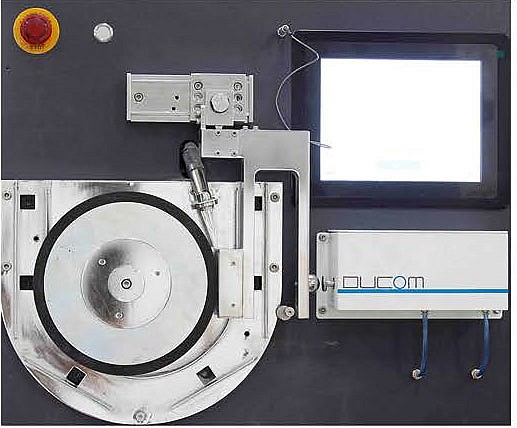
Ducom abrasion meter
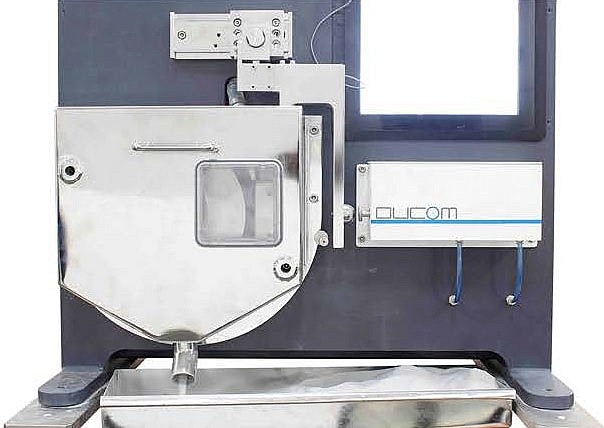
Abrasive in the Ducom device
 - Dry Abrasion Test GIF.gif)
Rotating disk, block, nozzle
 - Automatic Loading System GIF.gif)
Sample loading (pneumatic)
REGULATORY DOCUMENTATION REQUIREMENTS FOR TESTING TO DETERMINE ABRASIVE WEARASTM B611 ASTM G65 ASTM G105 Load (N)
200
130
222
Speed (rpm)
100
245
245
Abrasive feed (g/min)
-
300-400
-
Number of revolutions
1000
-
-
Disc material
Annealed steel AISI 1020
Steel disc with an outer layer of compressed rubber based on chlorobutyl
Steel disc with neoprene rubber outer layer
Disc size, mm
Ø 169 (max)
Ø 165 (min)
Width: 12.7Ø 228.6
Ø 178
Width: 13Sample material
-
Tool steel AISI D-2
Tool steel AISI H-13
Steel 4340Any metallic material suitable for abrasion testing
Sample size, mm
Thickness: 5 (min)
25 x 76 (LxW)
3.2 to 12.7 (thickness)
(rectangular shape)57.2 x25.4 (L x W)
6.4 to 15.9 mm (thickness)Abrasive requirements
1 cm³ water/4 g aluminum oxide
Corrund AFS 50/70
0.940 kg deionized water and 1.5 kg AFS 50/70 corundum
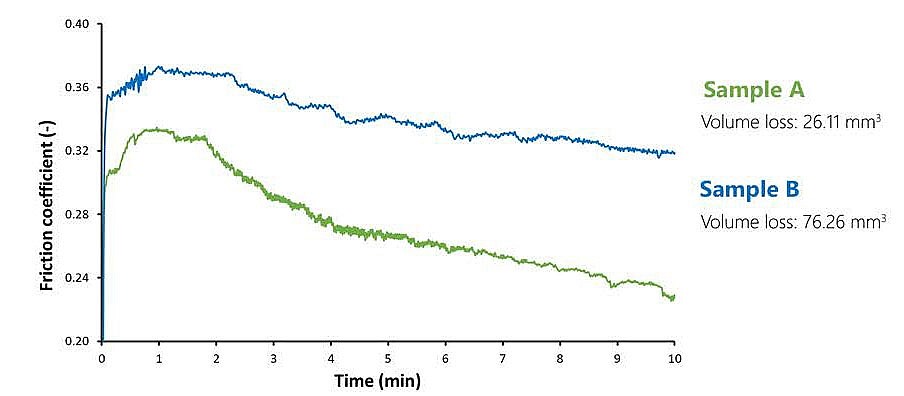
Coefficient of friction of samples after testing using a Ducom abrasion meter