Solicitar precio
Testing machine
SRV-tribometer
The fretting wear testing machine DUCOM type SRV-tribometer is designed to determine the abrasion characteristics of materials, coatings and lubricants that are subject to low amplitude cyclic motion.
It can handle a variety of sample geometries to model point, line, and area contacts. Custom sample holders can be supplied to simulate conformal contacts such as a sectioned cylinder liner with piston ring and engine seat valve contacts. The system is computer controlled, fully automated and includes a data acquisition system that is used to obtain, view, compare and analyze results.
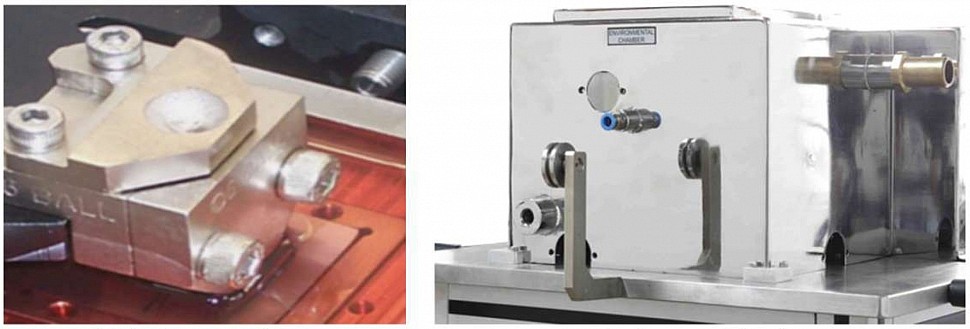
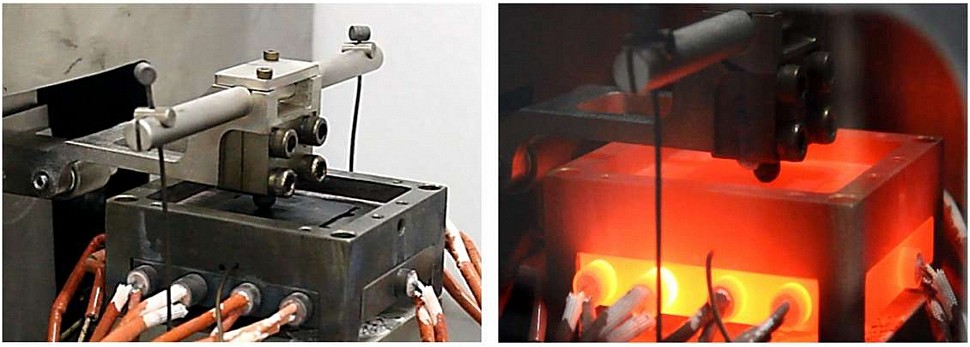
The DUCOM fretting corrosion testing machine can generate an automatic load of up to 1000N, has a wide frequency range from 1 to 500Hz and a stroke of 0.05-10mm. Additional modules integrated into the base instrument include a heating module up to 800°C, humidity control up to 90%, tribocorrosion module (Figure 2), vacuum up to 10-7 Torr and a lubrication module for temperatures of 200°C and above.
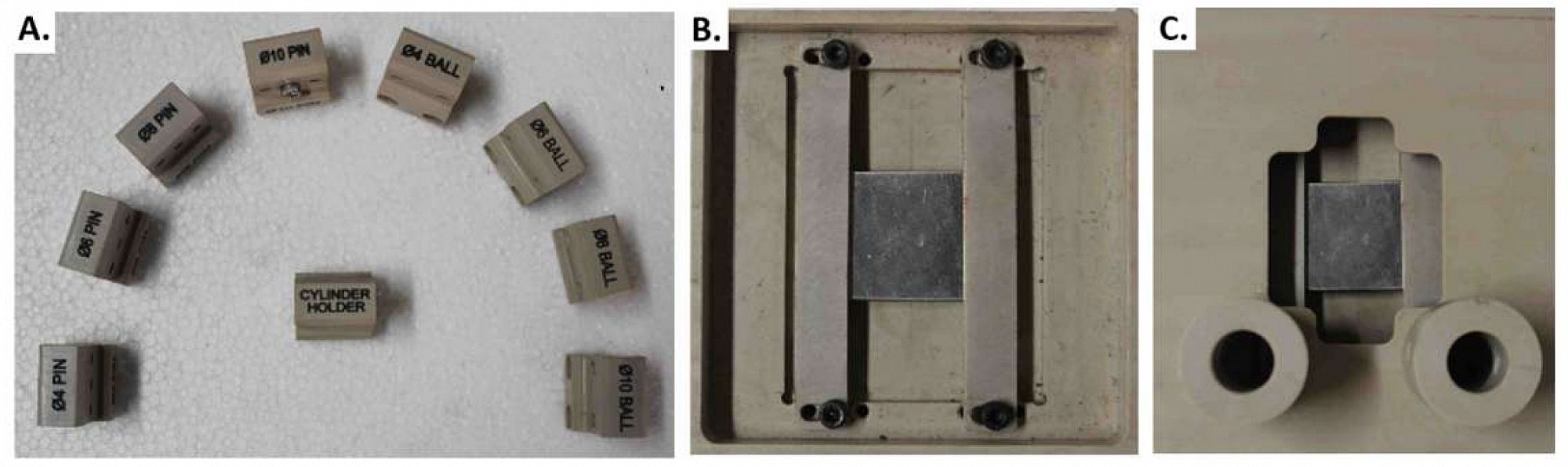
Rice. 2.
A. Options for various top PEEK sample holders (pin, ball, cylinder);
B. Bottom disk sample holder;
C. Device for connecting electrodes (meter, reference electrode) during tribocorrosion tests.APPLICATION AREA- Vibration-induced wear of steam generator pipes in power plants.
- Characteristics of coatings used in biomedical devices (TiN, DLC, PCD, etc.) during wear and tribocorrosion.
- Fatigue abrasion and wear of advanced superalloys and coatings used in gas turbine components such as blade dovetails and nozzle-bushing assemblies.
- Lubrication and grease in conditions of scarcity and elevated temperatures.
- Fretting wear resistance of greases.
- Testing materials for the space industry under high vacuum and temperature conditions.
- The influence of humidity on the rate of fretting wear in hydroelectric power plants.
- High temperature abrasive wear on engine valve seats and turbocharger components.
FUNCTIONAL FEATURESAutomatic load
The load is controlled by software via a servo drive. Static, stepped and gradually increasing loads can be used. A load of up to 1000 N is offered with an accuracy of 1 ± 1% of the measured value in N. The load setting step is 0.1 N.
Computer controlled linear reciprocating module
An electromagnetic drive driven by a linear winding provides fretting motion. This module offers a wide frequency range from 1 to 500 Hz with precise stroke control from 0.05 to 10 mm. The device allows you to study different fretting modes: from sticking to partial sliding or full sliding.
Lubrication module
The grease cup allows the lower specimen to be immersed in the grease. It also has a controlled drip lubrication mode to simulate various operating conditions in a lubricating environment (eg: engine in cars).
High temperature module
The bottom sample can be heated using cartridge type heating elements and provides fast and stable heating. Maximum temperatures up to 800 °C can be achieved with an accuracy of ± 1% of the measured value in °C.
Humidity module
The relative humidity in the closed chamber can be adjusted from 30% to 75%. Humidity is controlled by a solenoid valve set and two columns in the chamber that: (1) generate dry air and (2) generate saturated (humid) air using a compressed air supply.
Electrical Contact Resistance (ECR)
Contact resistance is useful for assessing the stability of a lubricant during friction between an upper and lower specimen, which is measured using the voltage drop method. The upper and lower sample holders are made of non-conductive materials.
Tribocorrosion module
A tribocorrosion setup with a three-electrode potentiostat for generating linear polarization curves is used to determine mass loss due to corrosion and mechanical wear.
Acoustic emissions
Helps detect crack formation under fretting fatigue conditions.
Image acquisition system
For fast and accurate measurement of wear marks.
PRINCIPLE OF OPERATIONThe DUCOM fretting corrosion testing machine consists of several units, as shown in Figure 3. Friction, temperature and displacement sensors are located on the base plate. The design of the base unit is capable of absorbing all forces generated during testing and minimizing vibrations. The test load is applied using a set of weights or servo control (optional).
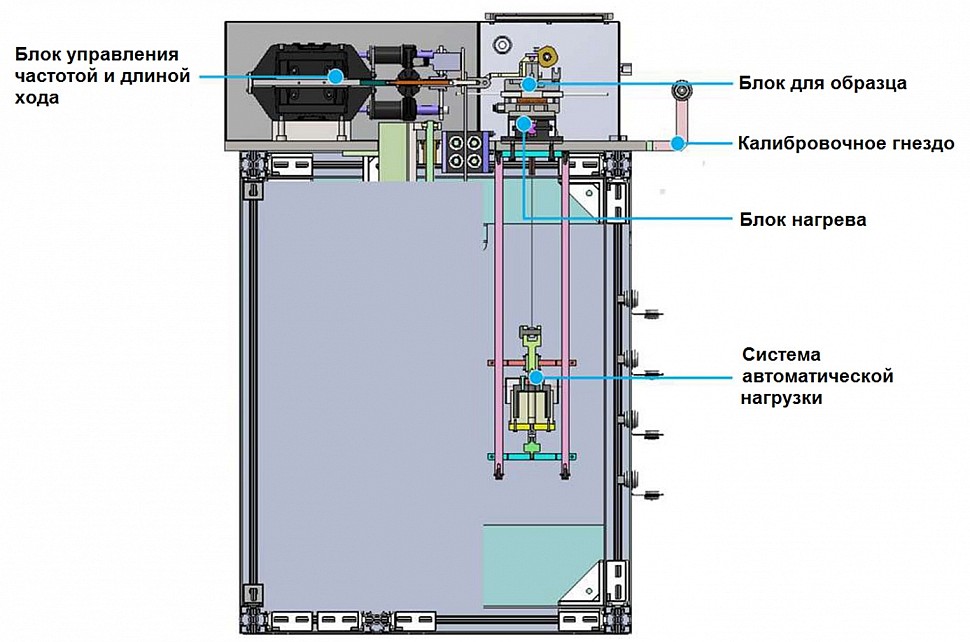
Rice. 3. Sectional view of DUCOM fretting corrosion testing machine
Linear reciprocating motion is carried out by an electromagnetic drive (Fig. 4). The electromagnetic drive shaft is connected to a reciprocating bracket, which, in turn, is connected to the loading shaft through a stiffening plate. The upper sample holder lever is attached here. Stroke length adjustment is fully automatic. The normal load is applied to the top sample using a linear winding (automatic load). The lower sample is attached to a cup of lubricant, which is heated externally by a cartridge-type heater. A water recirculation unit is used to cool the system. The load cell is connected to an elbow carrying a piezoelectric sensor, which is used to measure the friction force generated at the contact boundary. The entire installation is enclosed in a climate chamber with a humidity control system.
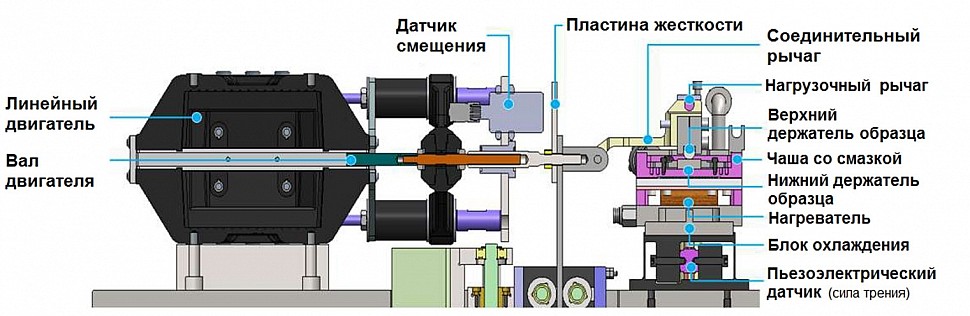
Rice. 4. Sectional view of DUCOM fretting corrosion testing machine
SOFTWAREThe DUCOM roller friction machine is equipped with WinDUCOM 2010 software, compatible with Windows OS.
Software Features:
Friendly interface
the software controls the conduct of the study with user-entered parameters. Information about the sample is entered before the start of the test, for the further generation of a report on the experiment.
Ease of interpretation and ability to export data
WinDUCOM software displays rotation speed, wear, temperature and speed, friction force, sliding speed, friction path and test duration.
Plotting graphs based on experimental data online
The obtained data can be displayed both graphically and in Excel format.
Flexible setup of experiment parameters
SpecificationsParameter Range Notes Automatic load (kN) 0.1 - 8 Automatic loading system uses its own compressed air system Speed (rpm) 2 - 2000 Servo motor power supply driving the upper and lower rollers to achieve clean experimentation under sliding conditions Slip rate (%) 0 - 200 SRR = Relative Rate/Average Rate 200% = 2 X (1998/2002) Linear wear (nm) 0 - 2 An LVDT sensor is used to record the deformation (insertion and wear of the specimen and counterbody) between two rollers during testing. Friction torque (Nm) 0 - 115 The rated power supplied to the motor/roller is 6.1 kW.
Examples of test parameters:
500 rpm/115 Nm, 2000 rpm/30 Nm, etc.Lubricant temperature (°C) From room temperature to 120 1. The lower roller is immersed in a removable container with lubricant
2. The container with lubricant is heated to 120 °C. The temperature of the lubricant is continuously measured during the test using built-in heaters.Possible loading and contact schemes 1. Roller on roller
2. Pin on roller
3. Block on roller
4. Ball on rollerRoller width (mm) 10 Roller diameter can be 60 mm or 47 mm (optional) Pin diameter(mm) 8 Ball diameter (mm) 8 Block size (mm) 8 x 8 Voltage 380 V, 32 A, 50 Hz, 3 phases Air Compressed air 6 bar (200 l/min) Weight 450 kg Overall dimensions, W x D x H (mm) 800 x 600 x 1200 SYSTEM DELIVERY SET- Roller friction machine DUCOM, base unit:
- Electronic controller for automated system control.
- Set of sensors.
- Automatic loading module.
- Set of power cables and compressed air.
- A computer with pre-installed software for data collection and analysis. Including one CD with WinDUCOM software.
- Calibration Tool Set
- Test rollers, set of 10 pcs.
- Standard samples (Pins and balls), set of 10 pcs.
- Standard samples (blocks), set of 10 pcs.
- Set of auxiliary equipment.
- A set of shipping documentation in Russian: passport, instruction manual.
- Container for working with lubricant, with the ability to heat up to 120° C
- Automatic load control module from 10 to 1000 N
- Automatic load control module from 1000 to 8000 N
- High temperature chamber up to 700 °C