Request a price
Universal tribometer
POD-4.0
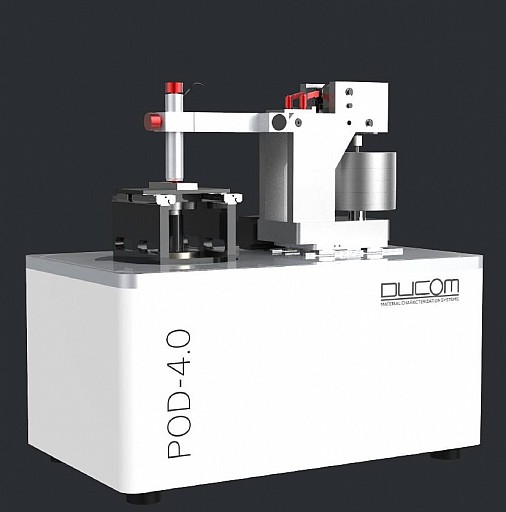
The DUCOM POD-4.0 tribometer is designed to perform tests in accordance with ISO, ASTM and DIN standards and provides high accuracy and repeatability of results in friction and wear studies.
The DUCOM POD-4.0 installation is designed to study the tribological properties of materials under unidirectional sliding (clockwise and counterclockwise), as well as bidirectional sliding (rotational and linear).
The motion module is controlled using a precise wear track positioning system (manually or automatically).
The high level of automation and the ability to fully program the experimental process in the DUCOM POD-4.0 installation allows the user to conduct tribological tests in various environments and conditions with minimal operator intervention.
To meet research needs under different conditions, DUCOM POD-4.0 tribometers can be equipped with a wide range of additional equipment.
Drive design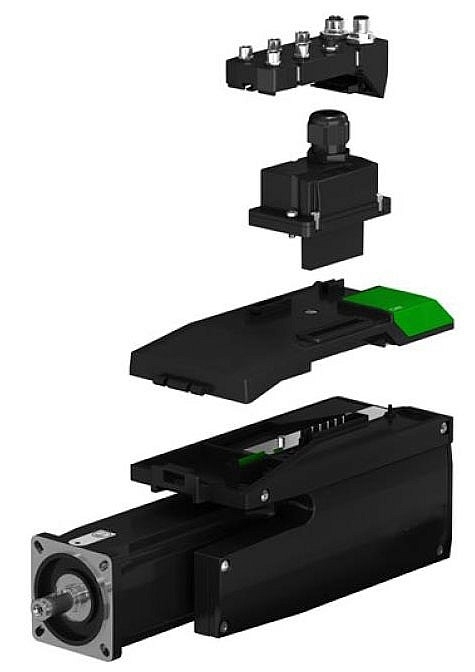
The DUCOM POD-4.0 installation has a powerful rotary drive that demonstrates high performance at minimum and maximum rotation speeds.
DUCOM's custom Advanced Motion Control (AMC) system provides precise, user-configurable angular coupling, reciprocating and reciprocating motion modes.
Engine configuration options:
Standard
200 - 2000 rpmHigh performance
0.1 to 3000 rpmImproved
Advanced Motion Control Package (AMCP). In addition to the High Performance option, AMCP provides angular coupling capabilities and reciprocating motion of the working fluid.LOADING SYSTEMThe ability to accurately adjust the friction path is the basis for conducting high-quality tribological tests. The DUCOM POD 4.0 installation is equipped with a high-strength modular loading system, and provides the possibility of the most precise adjustment of the friction track.
The loading scheme used in DUCOM POD-4.0 ensures that the load of the working fluid (pin or ball) is set independently of the friction console, which reduces the likelihood of vibrations in the system and improves the quality of the test.
The DUCOM POD-4.0 installation comes in two configuration options:
MANUAL LOADING SYSTEM
With this installation configuration, the load on the sample is set and controlled by the user manually.
Manual loading optionsfrom 0.1 to 100 Nfrom 5 to 200 NAUTOMATIC LOADING SYSTEM
The automatic loading system provides the ability to accurately program the task, maintain and automatically switch the sequence of loads on the sample.
The automated wear track correction option allows the user to conduct long multi-track tests without operator intervention.
Automatic Loading Optionsfrom 0.1 to 100 Nfrom 5 to 200 N
Parametresis of the friction trackThe universal tribometer DUCOM POD-4.0, depending on the installation configuration, can be equipped with two mechanisms for forming a wear mark.
When using the manual wear track adjustment module, the operator can set the sample position using the micrometer head; this is a simple, fast and cheap way.
The automated wear mark correction module is designed to parameterize the wear mark in automatic mode using software.
The advantage of the automated method: wear rate calculation and data recording with automatic recording in the experiment report.
Regardless of the system configuration, the installation of DUCOM POD-4.0 provides the ability to create a wear mark with linear movement of up to 50 mm.
Friction force measurementThe universal friction arm, designed to impart stiffness under loading, is responsible for accurate measurements of tribological characteristics. The console is designed to minimize heat transfer to the sensors when using a high temperature module. Dual friction force sensors minimize thermal expansion.
Options:
- Friction force measurement in the range up to 100 N
- Friction force measurement in the range of up to 200 N
STUDY OF FRICTION AND WEAR IN LINEAR MOTION{*The Linear Reciprocating Module (LRM) is a specialized option for the DUCOM POD-4.0 tribometer, which allows you to reproduce linear reciprocating motion, a flat, pin or ball tip is loaded with a certain weight. The test samples can have different shapes (for example, cylindrical). The length of the track can be adjusted before starting the measurement. Once the test begins, the tip creates a linear wear path.
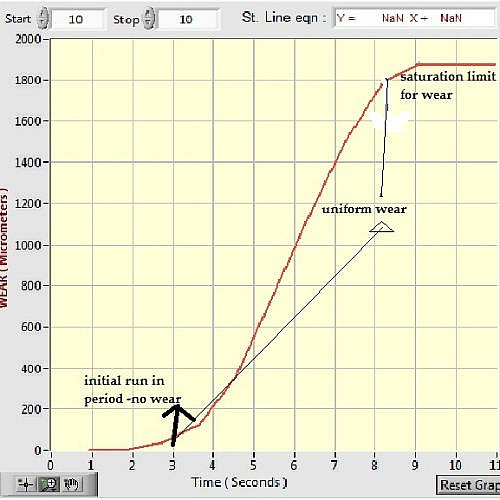
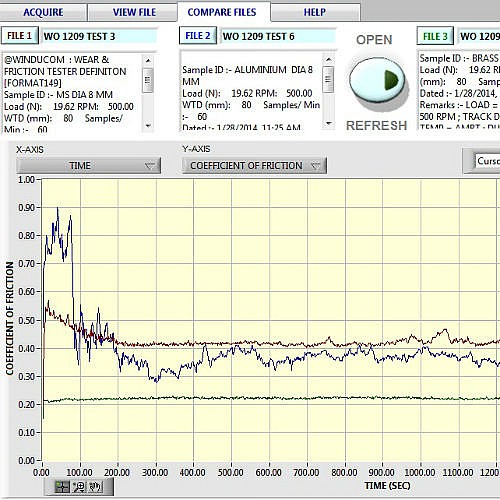
Friction forces are recorded both when moving forward and when moving backward. The speed of movement corresponds to a sine wave with a maximum speed in the middle of the track. Friction will change at each position of the track, depending on the speed and direction of movement. Wear rates for the counterbody and specimen are calculated from the mass of material lost.
The linear wear module provides accurate and simple measurement of friction force.
*}
Standards:
ASTM G133 / ASTM G171
Parameters analyzed in the “Linear” mode:
friction coefficient / wear / electrical resistance / lubrication and corrosion studies / friction versus speed / scratch hardness / static coefficient of friction and others.Counterbody.
Material - diamond, tungsten carbide, steel and other materials: 1, 3, 6 or 10 mm ball,
custom ball size, flat surface, free geometry.Optional equipment:
- oven at 400 °C
- liquid container and liquid container heated to 120 °C
Mounting samples:
vices, clips, custom grips for samples of various geometries.
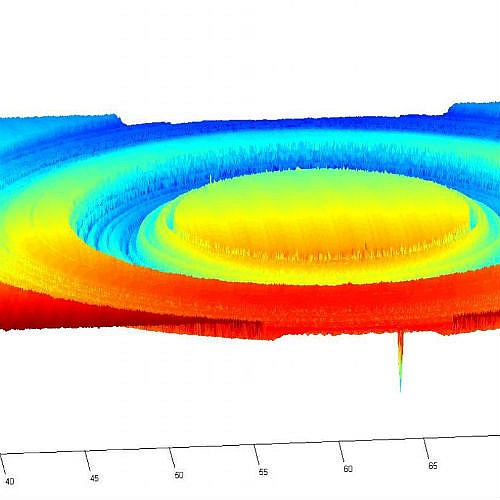
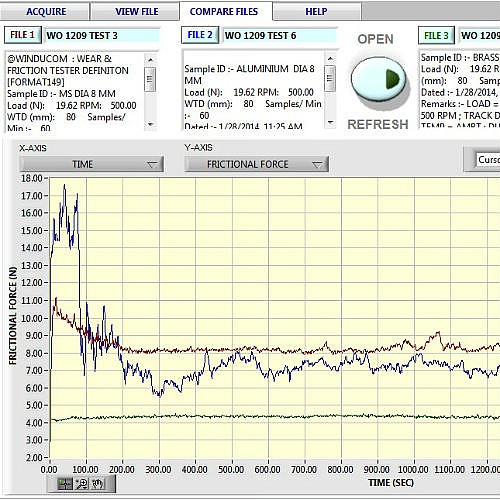
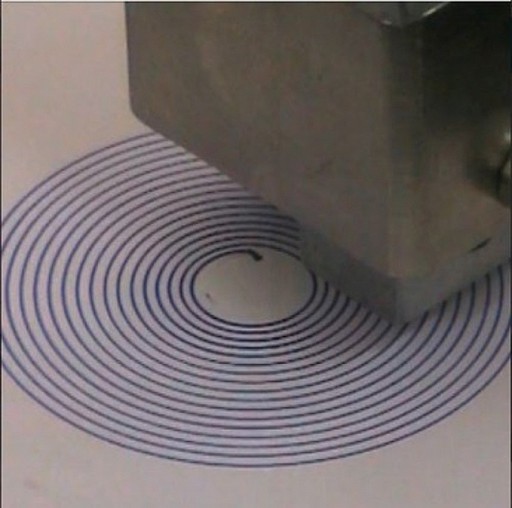
STUDY OF FRICTION AND WEAR IN ROTATION MODETribological tests in rotary motion mode reproduce the rotational motions that are often found in real mechanisms. A counterbody in the form of a ball, needle or rod is applied to the sample under study with a given load and at a certain distance from the center of rotation. As the counterbody moves, it creates a wear groove on the specimen. The coefficient of friction is calculated using a precision load cell and can be determined for any point or zone of interest during each test cycle. In addition, it is possible to quickly and smoothly change the rotation speed from 0.1 to 2000 rpm to obtain the dependence of the friction coefficient on speed. Speeds up to 0.1 rpm are important for studying friction in the static region and for understanding the transition from a static coefficient of friction to a dynamic one. The wear rate can be calculated from a 2D or 3D wear groove profile.
Standards:
ASTM G99 / DIN 50324 / ASTM D3702 / ASTM D2266 / ASTM D4172 / ASTM G132
Parameters analyzed in rotation mode:
friction coefficient / wear / electrical resistance / lubrication studies / friction versus speed / stroke curve / scratch hardness / static friction coefficient and others.Counterbody.
Material - diamond, tungsten carbide, steel and other materials: 1, 3, 6 or 10 mm ball,
custom ball size, flat surface, free geometry.Optional equipment:
- completely removable oven at 1000 °C
- liquid container and liquid container heated to 120 °C
Mounting samples:
vices, clips, custom grips for samples of various geometries.
 TESTING AT HIGH TEMPERATURES
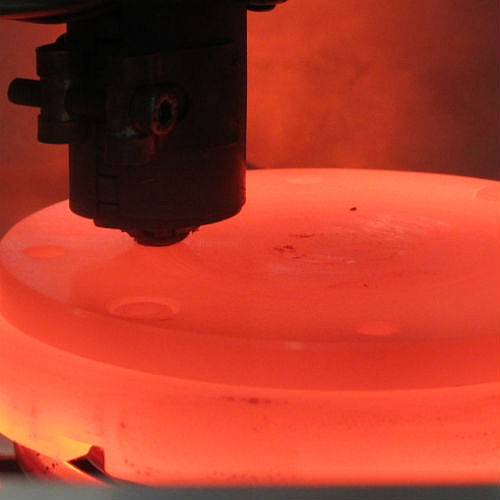
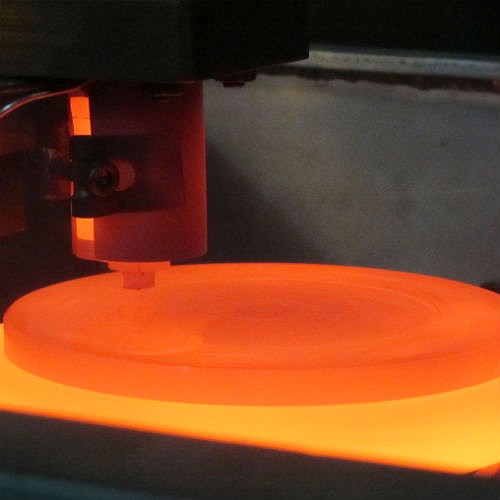
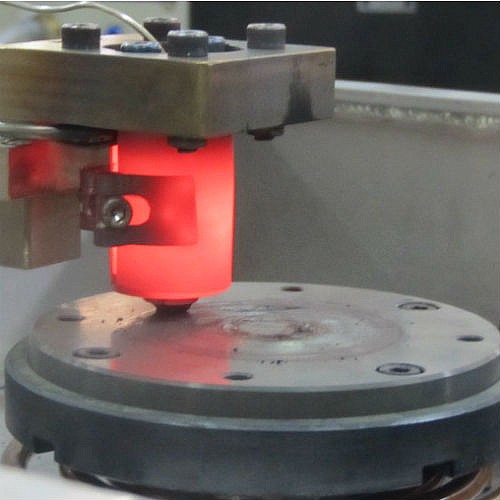
Tribometers DUCOM POD-4.0 allow you to study the wear of materials at elevated temperatures up to 1000 °C in rotation mode and up to 400 °C in linear movement mode. Thermocouple built into the furnace ensures uniform and stable temperature distribution around the sample.
Reliability of the installation during high-temperature tests is ensured through the use of heat-resistant alloys in device components operating at extremely high temperatures. The drive is protected from temperature effects and overheating through the use of carefully selected insulating materials and a specialized design of bearings and shafts.
The installation is designed on a block-modular principle and allows for various types of tests. The oven can be replaced with a low-temperature chamber, which allows testing at temperatures down to -40 °C.
The cooling system can be supplied in two versions:
- Water cooling based on a chiller, requires periodic maintenance;
- Super sealed oven: no maintenance or additional utilities required.
Standards:
ASTM G99 / ASTM G133
Analyzed parameters:
Friction coefficient, wear, dependence of the friction coefficient and wear on temperature.
Software features:
- friction and wear at different temperatures
- speed change during the test and others.
Counterbody.
Material - diamond, tungsten carbide, steel and other materials: 1, 3, 6 or 10 mm ball,
custom ball size, flat surface, free geometry.Mounting samples:
vices, clips, custom grips for samples of various geometries.
 TESTING IN LIQUID ENVIRONMENTS
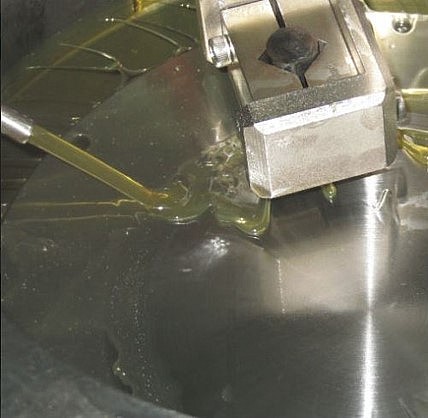
The DUCOM POD-4.0 tribometer provides fluid/lubricant wear and friction studies for the linear and rotary modules. Various solutions can be used to simulate wear processes occurring under conditions close to real ones. The setup allows you to study wear and friction of materials in liquid or lubricant for various industrial applications.
It is possible to heat the liquid up to 150 °C. In droplet mode, research is possible even at a very high rotation speed of 2000 rpm.
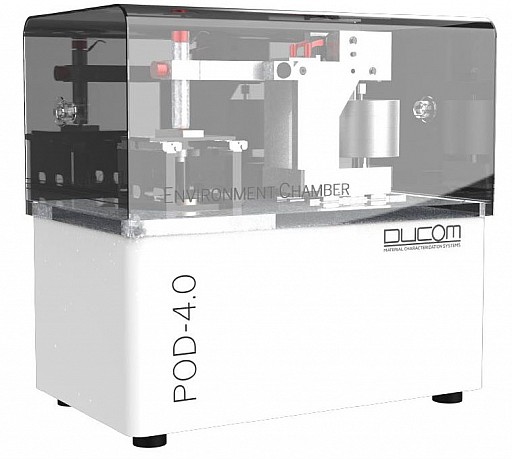
MEDIUM SUPPLY CHAMBERDesigned for conducting tribological studies in an inert gas or vacuum environment. The chamber is sealed and equipped with two feed ports, inlet and outlet. The transparent cover allows the operator to visually inspect the samples during testing. The fully removable design allows easy, convenient and safe access to the test area.
Standards:
ASTM G99 / ASTM G133
Analyzed parameters:
Friction coefficient, wear, dependence of the coefficient of friction and wear on temperature, dependence of the coefficient of friction and wear on speed.
Software features:
- friction and wear at different temperatures
- speed change during the test and others.
Counterbody.
Material - diamond, tungsten carbide, steel and other materials: 1, 3, 6 or 10 mm ball,
custom ball size, flat surface, free geometry.Mounting samples:
vices, clips, custom grips for samples of various geometries.
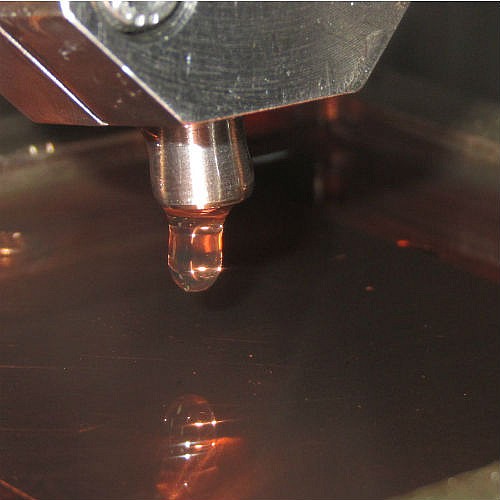 Tribo-corrosion module
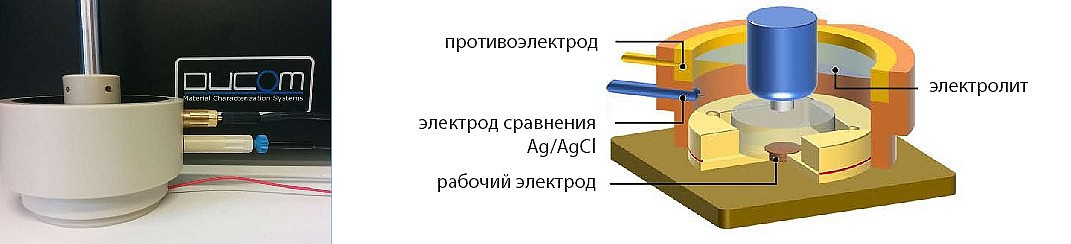
Designed to evaluate the electrochemical behavior of materials during friction and wear tests, the Ducom Multi Autolab tribocorrosion module is installed.
The system is additionally equipped with a specialized Multi Autolab module, which is a multichannel potentiostat/galvanostat. It allows you to determine resistance, corrosion rate (mm/year), corrosion current, corrosion potential according to ASTM G59 and ASTM G102. All devices are made of dielectric materials.
 SPECIFICATIONS
Parameter Dimension Meaning Potential difference IN ±10 Voltage IN ±20 Maximum current mA ±400 Current range - ±10 mA to 10A Potential Accuracy % ±2 Potential Resolution nB 3 Impedance Gohm >100 MEASURED PARAMETERS
Corrosion current, linear polarization curves, mass loss.
PECULIARITIES
A three-electrode electrochemical cell is installed to measure potential and current. Simultaneous acquisition of frictional wear data with corrosion current.
APPLICATION
Determination of mass loss due to corrosion of materials during linear polarization curves.
Standards:
ASTM G59 and ASTM G102.
Analyzed parameters:
Friction coefficient, wear, corrosion resistance, tribocorrosion.
Software features:
Wear at steady-state potential, wear at anodic/cathode potential, electrochemical impedance spectroscopy, speed monitoring.
Environmental conditions:
Various solutions to simulate real conditions, accelerate/decelerate corrosion.
Counterbody.
Material - diamond, tungsten carbide, steel and other materials: 1, 3, 6 or 10 mm ball,
custom ball size, flat surface, free geometry.Mounting samples:
vices, clips, custom grips for samples of various geometries.
CONTENTS OF DELIVERYUniversal tribometer POD-4.0
rotation module (basic kit)Load from 0.5 to 60N / 100N / 200N
(ASTM G99, DIN50324)
Speed from 1 to 2000 rpm
Friction from 0 to 60N / 100N / 200N
Linear wear from 0 to 2 mm
Oscillation frequency from 0 to 5 Hz
Amplitude from 10 to 90°
Pin or ball grip:
3 mm, 6 mm, 10 mm, 12 mm
Wear track diameter:
2 mm to 30 mm/60 mmUniversal tribometer POD-4.0
linear displacement module (T < 200°C)Frequency from 0.5 to 50 Hz
Stroke length from 1 to 50 mm
Load from 2 to 60N / 40 / 200N
(ASTM G133)
Friction force from 0 to 60N / 40N / 200N
Pin or ball grip:
3 mm, 6 mm, 10 mm, 12 mm
Disc grip: 50 mm x 50 mm x 5 mmUniversal tribometer POD-4.0
linear displacement module (T > 600°C)Frequency from 0.5 to 50 Hz
Stroke length from 1 to 50 mm
Hand load from 2 to 50 N Friction
force from 0 to 100 N
Pin or ball grip:
3 mm, 6 mm, 10 mm, 12 mm
Disc grip: 50 mm x 50 mm x 5 mmAdditional options- Digital multimeter
- Container for working with lubricant, with the ability to heat up to 200 ° C
- Fluid circulation system
- Tribo-corrosion module
- Universal holder (in rotation mode, sample diameter up to 54 mm, used only at room temperature)
- Profilometer (needle)
- High temperature module up to 400 °C
- High temperature module up to 600 °C
- High temperature module up to 1000 °C
- Automatic loading system module (up to 2 kN)
- Motor (rotation speed up to 5000 rpm)
- Low temperature module up to -40 °C
- Humidity control (30 to 85%)
- Chamber with inert gas and vacuum supply
- Acoustic emission sensor
SPECIFICATIONSParameter Meaning Range of value of the specified normal load From 0.1 to 100N From 5 to 200N Range of the specified friction force Up to 100 N Up to 200 N Working fluid rotation speed Standard: 200 to 2000 rpm
High Performance: 0.1 to 3000 rpmEngine torque 2 Nm Oscillatory motion (angular) Movement from +/-5 to +/-150 degrees.
Frequency: 0.1 to 10 HzOscillatory motion (linear) Movement up to 25 mm of pressure
Frequency: 10 HzPeculiarities- Real-time DAQ data analysis system
- Ease of fast use of DAQ
- Real-time friction force measurement and graphical display as a function of time, cycles and sliding distance
- Integrated software module for contact pressure, contact radius and contact zone
- Built-in temperature sensors
- Automatic generation of an experiment report