Request a price
Research stand
System FT 5
Application:
- Determination of flocculation centers
- Study of the deposition process of asphaltenes and paraffins
- Determination of the presence of solid phase
- Oil research in dynamic mode
- Suitable for very dark oils
- Works independently or using a computer
- No need to liquefy (after liquefying the raw sample, it is recommended to wait 40-80 hours to establish phase equilibrium)
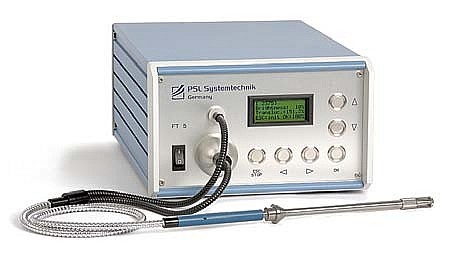
In field version
Installation diagram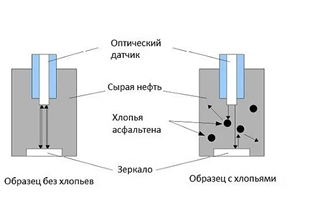
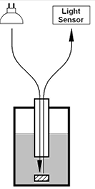
Operating principle of the device
If a sample containing asphaltenes is titrated with a precipitant, the chemical balance changes until the asphaltene precipitation process is complete. Up to this point, the sample simply liquefies, which can be observed due to an increase in partial light transmission. This occurs due to the fact that the sample becomes optically “thinner”, that is, it transmits more light.
Once asphaltenes form flocs (colloids), they begin to scatter light. Due to this scattering, less light can pass through the sample, resulting in a decrease in the light transmittance of the sample.
After this, two phenomena occur in parallel: on the one hand, further liquefaction of the sample due to the titration of the liquid (therefore the gradient increases), and on the other, asphaltenes precipitate, which leads to an increase in light scattering, that is, a decrease in light transmittance. Liquefaction is an almost permanent process. The precipitation starts slowly, then occurs more quickly and reaches a constant value when the process is completed.
The combination of the two processes is shown
in a typical measurement diagramOn it you can see a linear increase in light transmission at first, then a decrease in the gradient until a maximum critical point, after which the gradient begins to fall. This drop marks the beginning of asphaltene precipitation. The amount of asphaltenes in the original sample can be calculated from the ratio between the volume of the sample and the precipitant at the point where precipitation begins. Further titration leads to the formation of more asphaltene crystals, which results in a decrease in partial light transmission and a drop in the gradient. The process is completed when all asphaltenes dissolved in the sample crystallize. This moment is reflected by the minimum critical point in the diagram. Further titration only leads to sample dilution and does not increase sedimentation. This is evidenced by a further increase in light transmittance and an increase in the measuring gradient.
Additional equipment for testing under ambient pressure
Testing facility for laboratory conditions
- Test chamber with internal volume 265 ml, aluminum, for operations without additional pressure, maximum temperature +80 °C (176 °F)
- Optical sensor, stainless steel
- Double-shell tank, thermally insulated
- Ports for optical sensor, temperature sensor, titration inlet and outlet
- Adapter for PT100 sensor
- Special glass glasses (2 pcs.)
- Built-in magnetic stirrer controlled by computer
- Pipes, connections and adapters for inlet/outlet
Dosing Pump – to create external pressure
Dosing pump for titration and mixing
- Accurate pump indicator diagram
- For titration and mixing with condensate / diesel / light oil
- Maximum flow 30 ml/min
- Pump head made of PVDF, diaphragm and seal made of fluoroelastomer
- Full computer control with PSL WinFloc software
- 230 V / 50 Hz (possibly 110 V / 50 Hz)
Titration Pump – to create external pressure
High precision dosing pump
- Maximum flow rate 150 ml/min, division value 0.001 ml
- Glass/ceramic pump head, FEP, PPTFE/PTFE
- Full computer control with PSL WinFloc software
- 230 V / 50 Hz (possibly 110 V / 50 Hz)
Additional Equipment for High Pressure Testing
Test setup for upflow conditions
- Maximum pressure 700 bar (70 MPa, 10000 psi), maximum temperature 150 °C (302 °F)
- 700 bar (70 MPa) optical sensor, compatible with metal wellhead equipment
- High pressure reservoir, internal volume 265 ml, high quality stainless steel
- Special clamping head for easy opening/closing
- Double-shell tank, thermally insulated
- Ports for optical sensor, temperature sensor, titration inlet and outlet
- Pressure sensor, high pressure temperature sensor PT100 1/8'' NPT
- Special glass glasses (2 pcs.)
- Replaceable housing for sample recovery
- Built-in magnetic stirrer controlled by computer
- Pipes, inlet/outlet fittings and adapters, valves, burst disc
- Meets the requirements of the EU directive "EC Directive 97/23/EG" and the German standard for pressure systems "AD2008", tested by the German Technical Supervision Authority (TÜV)
High pressure pump – to create high pressure
High pressure pump for titration
- HPLC pump, maximum pressure 700 bar (70 MPa, 10,000 psi)
- Maximum flow rate 5 ml/min
- Stainless steel pump head, ceramic inlet, piston backwash
- Full computer control with PSL WinFloc software
- 230 V / 50 Hz (possibly 110 V / 50 Hz)
WinFloc Software
FT Monitoring and Analysis Software
- Controlling the FT5 Flake Meter
- Regulation of the temperature of the circulation bath with the ability to set temperature settings (constant / variable temperature)
- Flow control and start/stop of titration pumps
- Magnetic stirrer control
- Automatic program control: setting the time / volume of titration / pre-titration, interrupting the titration when the minimum / maximum light transmission value is reached, setting the total time, etc.
- Data output to the display: temperature change, light transmittance change, titrated volume change
- Data visualization, export (to Excel), printing, storage
Circulation thermostat
Heating/cooling thermostat
- Circulating heating/cooling thermostat
- Temperature range -25..+150 °C, accuracy ± 0.1 °C
- Digital control, PID parameters optimized for FT5 Flake Meter tank
- Full computer control with PSL WinFloc software
- 230 V / 50 Hz (possibly 110 V / 50 Hz)
Personal Computer
Personal computer with a running operating system
- Dual Core CPU, HDD, DVD, monitor (19'')
- Computer mouse, LAN, serial interface, English keyboard
- Windows 7 English
- 110V-230 V/50-60 Hz (automatic selection)
- Installed WinCFC software (if purchased)
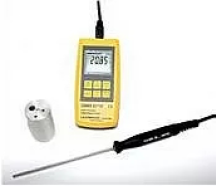
Temperature calibration kit
Personal computer with a running operating system
- For all PSL devices
- Replaces recalibration service
- High precision digital thermometer
- Calibrated by EA/ILAC
- Cable set
Parameter Meaning Photosensitivity
O0.005 lux
Temperature Range
up to +200°С (+392°F)
Built-in temperature sensor
PT100
Branched light guide of optical sensor
Optical sensor for operation under ambient pressure conditions
stainless steel
Voltage
110/240 V, frequency 50/60 Hz